The 2021 World Bodybuilding and Physique Sports Championship was held in Tashkent from 1 to 7 October 2021 under the world federation WBPF. The archive record of the Uzbekistan Bodybuilding and Fitness Federation gives the place as "Tashkent, Uzbekistan" and the start date as 1 October 2021; one results file is attached to the record, no specific hall is named, and the record itself holds not a single photograph. According to the result lists compiled in the monograph "Development of Bodybuilding in Uzbekistan" (Tashkent, 2026), the home stage produced at least four named lines for the national team: Elena Bekirova, first place in the open model physique category; Jakhongir Zhuraev, first place in the 75 kg weight category; Regina Mengnorova, second place in the open sport physique category; Pavel Umurzakov, second place in bodybuilding, masters 40–49, up to 80 kg. The monograph calls the overall result a historic record for the number of the team's gold medals, but gives no number — and neither will we.
What the documents actually say
The championship has its own page in the federation archive: "World Bodybuilding and Fitness Championship 2021 (WBPF)". The record is short: title, city, dates, a link to the results in PDF, and pointers to photos and video on outside platforms. Everything else about the tournament has to be reconstructed from the result lists of individual athletes, verified in the monograph "Development of Bodybuilding in Uzbekistan" (Tashkent, 2026), published by the ministry of sport, the university of physical culture and the federation.
| Athlete | Category | Place |
|---|---|---|
| Elena Bekirova | Model physique (women), open category | 1 |
| Jakhongir Zhuraev | 75 kg weight category | 1 |
| Regina Mengnorova | Sport physique (women), open category | 2 |
| Pavel Umurzakov | Bodybuilding, masters 40–49, up to 80 kg | 2 |
There is a fifth line, but it carries a question. Vitaly Skripachev, who won the classic bodybuilding category in 2014, says in his 2026 interview that he became world champion in 2021. The editorial notes attached to that same transcript state it plainly: it must still be established which 2021 world championship and which category the title was won in. Until that is settled the line stays open, and we leave it open.
How the country earned the right to host a world championship
The federation was founded in 2006. The international era began later: the notifications of admission to the world body WBPF and the Asian body ABBF arrived on 31 December 2012, and in the first days of January 2013 the federation announced it on its website. For the next seven years the national team learned on other people's stages.
- 2013, Budapest: Alexander Sakharov takes silver — the first world line in the federation's lists.
- 2014, India: Mikhail Volynkin wins the junior overall category.
- 2016: Pavel Umurzakov becomes the country's first bodybuilding world champion.
- 2017, Mongolia: gold for Volynkin in the over-100 kg category.
- 2018, Chiang Mai: Elena Bekirova and Pavel Umurzakov both win.
- 10 November 2019, Jeju: four golds in a single day — Bekirova, Rushana Maksumova, Umurzakov and Nikolai Filippov.
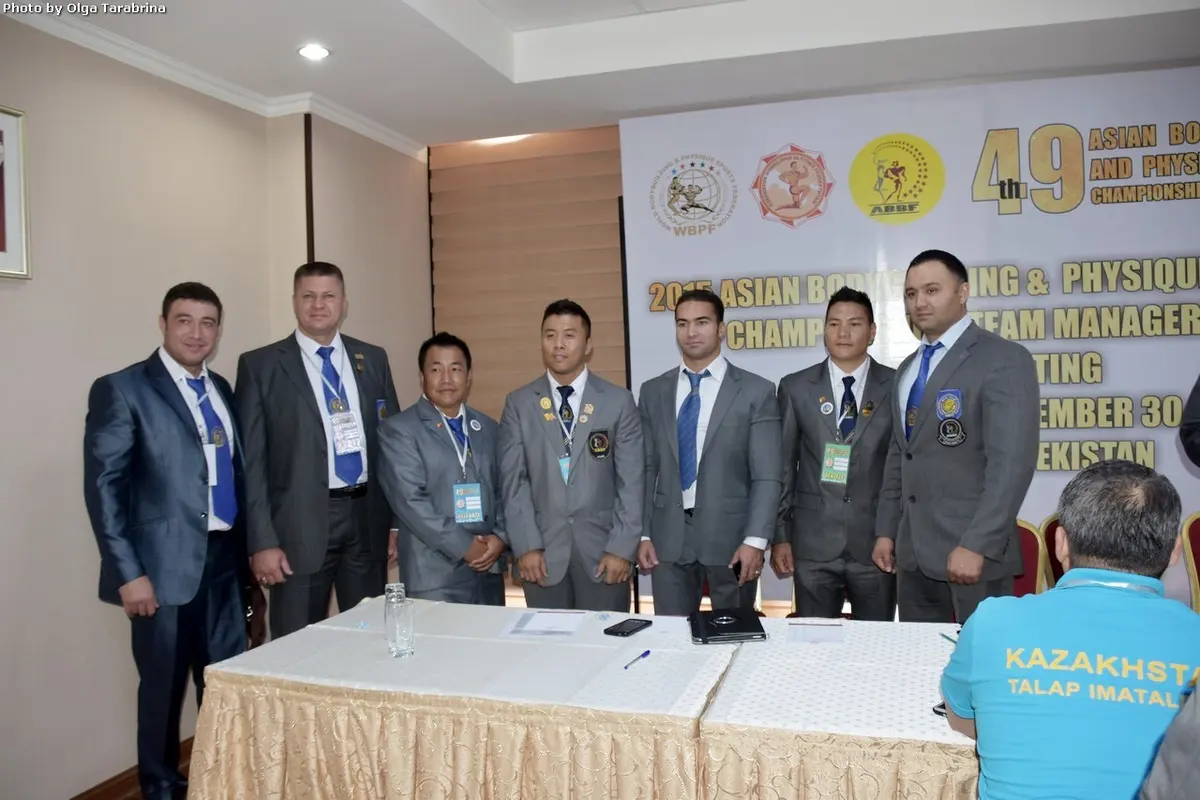
A second line ran in parallel, the organisational one, and it usually goes unnoticed. The real rehearsal was 2015: from 29 September to 4 October Tashkent hosted the 49th Asian Championship together with the ABBF congress. The archive record speaks of 23 countries and more than 300 athletes coming to the city that autumn. That tournament holds 90 photographs in the archive — level with the 2012 national championship, the largest photo set for a single competition in the whole collection. Hosting a continent and running the governing body's congress is exactly the examination a country passes before it is considered as host of a world championship.
Behind the organisational side there are people, not only dates. Among those who played a key role in building the federation the monograph names its president, Timur Sobirov: the organisation was built through constructive dialogue with the state sports structures. That dialogue is half the work of staging a world championship.
The year before: a championship behind closed doors
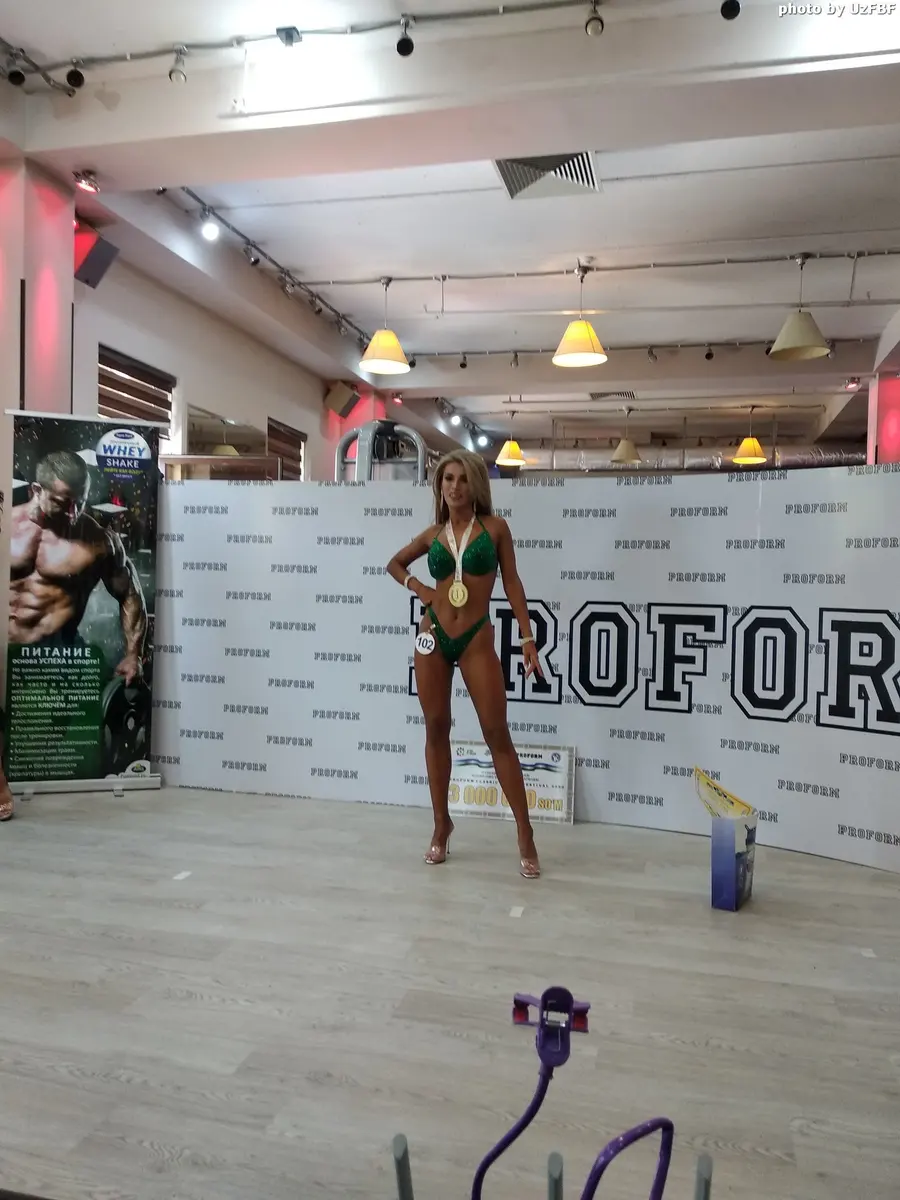
Between the rehearsal and the world championship stood 2020. The federation's announcement of that season's national championship puts it without decoration: because mass sporting events were banned during the coronavirus pandemic, the tournament would be held behind closed doors, with photo and video material published afterwards. Pre-registration ran on 6–7 August at the PROFORM sports club, the membership fee was 30,000 sum, and qualifying plus the final were set for 9 August. The archive record for that championship carries a different date — 13 September 2020. The announcement and the final record disagree, and that disagreement is part of the document too: the season was being moved as it went.
A year before the world championship the country could not gather spectators for its own national title. A little over a year later it was hosting the world. Those two lines belong side by side: they explain the size of the task better than any adjective.
Selection: 22 August, forty days before the world stage
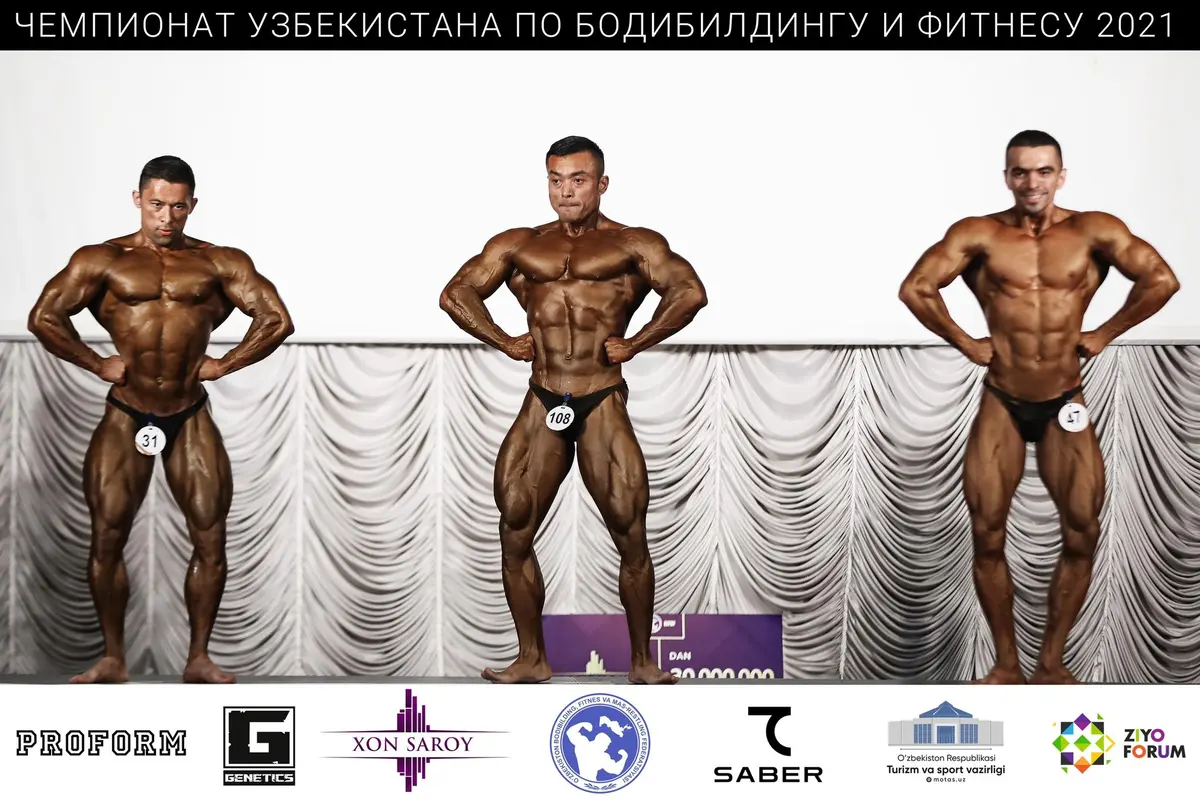
The 2021 national championship final took place on 22 August in Tashkent. A five-judge panel: Akmal Bazarov, Bakhtiyor Khaydarov, Sergey Nenashev, Eldar Kholmatov, Svetlana Chernova. The protocol runs category by category, from juniors up to 75 kg and onwards through the weights.
Three names from that protocol stepped onto the world stage in the same city exactly forty days later. Elena Bekirova won model physique up to 170 cm here, Regina Mengnorova won sport physique up to 165 cm, and Pavel Umurzakov won bodybuilding among masters 40–49 over 80 kg. The record of the national final holds 44 photographs: more than any other 2021 record in the archive, including the world championship itself.
The regions had been working earlier still: 14 March, the open championship of Navoi region; 28 March, the open championship of the Fergana Valley in Namangan; 4 April, the combined open championship of the Samarkand, Jizzakh, Kashkadarya and Surkhandarya regions. The archive holds seven records for 2021 in total. That is what a country's preparation for a world championship looks like in practice: not one date, but a season of regional stages funnelled into a single August protocol.
What the sources do not contain
- The name of the venue. The archive record for the championship gives only the city: "Tashkent, Uzbekistan". The venue is named neither in the record, nor in the monograph, nor in the book. So we will not name it either.
- Numbers of athletes and delegations. Around this championship the figures "about 350 athletes" and "more than 150 delegations" are often repeated. Neither figure appears in the files we checked. The verifiable figure of a comparable order belongs to 2015: 23 countries and more than 300 athletes at the Asian championship in Tashkent.
- The ordinal number of the championship. WBPF world championships are numbered in the archive: fifth in 2013, sixth in 2014, ninth in 2017, tenth in 2018. For 2021 no number is given in the sources.
- The exact count of gold medals. The monograph writes of a historic record and an unprecedented amount of gold, but supplies no figure. The book repeats the wording with a reference to the monograph. A record without a number stays a record without a number.
What this history actually rests on
It is worth looking once at the foundation under any account of 2021. The federation's online archive holds 225 records: 137 tournaments, 52 people, 18 calendars, 11 documents and 7 short stubs. Across the whole archive there are 2,623 photographs; counted over the 137 tournaments alone, 2,579. The document register lists 140 files, and those are not 140 protocols: it also holds rulebooks, entry forms, season calendars and inspection reports. The correct phrasing is therefore 140 documents, not 140 protocols.
The book on the federation's history keeps its own count and names 406 texts, 140 documents and 2,904 photographs. That figure belongs to the book and was fixed while it was being prepared; it is not today's count on the website, and the two must not be mixed.
And here the central paradox of the subject surfaces. The loudest event in the history of this sport in Uzbekistan has the thinnest record in its own archive: zero photographs, one results file and three links pointing outward. The celebration went into other people's feeds, and what stayed at home was a line in a protocol. That is precisely why the book on the federation's history photographed the 2021 tournament protocol and the medal as objects, on a dark background: when the noise of the hall dies down, the document is the only witness left.
What an ordinary gym takes from this
In his 2026 interview Vitaly Skripachev describes his preparation without secrets: six to seven months per cycle, a three-days-on, one-day-off schedule with cardio on the rest day, compound lifts at the centre of the programme to hold his strength numbers, sleep as the main tool of recovery, and a massage once a week. He changes his nutrition by period; he does not change his principle of working with iron. The title of his chapter is three words long.
Discipline is the head of everything.
Between a regional stage in Navoi and a world title lies not talent but a calendar: a season of starts, selection in August, the final in October. The same calendar works for an amateur, only with smaller numbers.
About the club
PROFORM DINAMO is a fitness club in Tashkent, Mirzo Ulugbek Avenue 8a. We are open around the clock, and a tour of the club is free. To book or to ask a question: +998 94 045 54 48.