
The first official bodybuilding competition in Uzbekistan was held in Tashkent in 1989: the Tashkent Open Championship took place at the sports complex of the Lenin Komsomol Park of Culture, and eight frames of that tournament are kept in the federation archive. The tournament line that still runs today begins three years later: on 26 December 1992 the «Mr. Tashkent 1992» tournament was held, and from that date the archive follows the «Mr. Tashkent» and «Mr. Uzbekistan» series almost without gaps — 1992, 1993, 1996, 1998, 1999 and 2000. The seven tournament records from 1992 to 1999 hold 66 photographs and not a single document: no protocols from those years survive in the archive.
This article is built only from material anyone can open and check: the tournament records in the public archive of the Uzbekistan Bodybuilding and Fitness Federation, the monograph «The Development of Bodybuilding in Uzbekistan» (Tashkent, 2026), and the chronicle volume prepared by the federation. Where the sources are silent, this article says so.
What came before 1992: Sparta, Leningrad and the first Tashkent championship
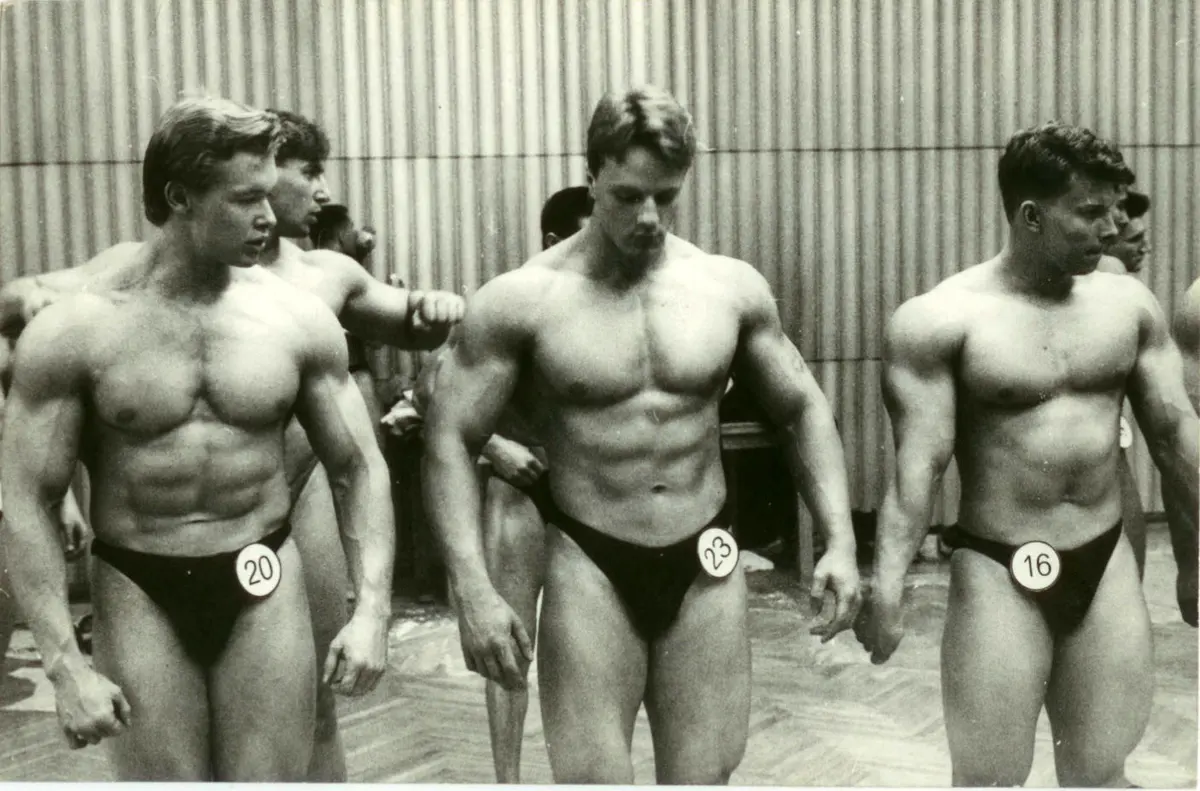
The earliest photographs in the archive are dated 1987. They show the Sparta gym in the Kirov Park: twenty-eight frames of black-and-white film, training suits, iron, faces of people at work. There is no tournament in this series — there is the work out of which the tournaments later grew.
From 26 to 28 May 1988 the first official USSR championship in this sport was held in Leningrad. The federation archive keeps three photographs from 1988 marked with the Sparta club, and names Yuriy Dementyev a medallist of that first championship. Exactly which place he took can only be settled by the Leningrad protocol, and that protocol has not yet been found; so the chronicle keeps to the precise word «medallist» and does not use the word «winner».
In 1989 competition came home: the Tashkent Open Championship. The monograph calls it the country's first official competition and dates the admission of women to the same year. The archive captions under the eight frames from 1989 already name the participants one by one.
Seven tournaments from 1992 to 1999: dates, names and what the archive holds
Below is the whole line of the nineties exactly as it sits in the archive. Dates, names and the number of surviving frames come from the record cards; the document column shows zero in every row, and that is not a typo.
| Date | Tournament | Photographs | Documents |
|---|---|---|---|
| 26 December 1992 | Mr. Tashkent 1992 | 7 | 0 |
| 20 November 1993 | Mr. Uzbekistan 1993 | 4 | 0 |
| 27 November 1996 | Mr. Tashkent 1996, open tournament | 8 | 0 |
| 26 April 1998 | Mr. Tashkent 1998 | 10 | 0 |
| 30 June 1998 | Mr. Tashkent — Navoi 1998, show tournament | 7 | 0 |
| 28 December 1998 | Mr. Uzbekistan 1998, republican championship | 7 | 0 |
| 1 May 1999 | Mr. and Ms. Tashkent 1999 | 23 | 0 |
| Total | 7 records | 66 | 0 |
For comparison: the federation's chronicle volume counts 169 photographs taken before 2000 across the whole archive. The seven tournament records of the nineties account for 66 of them. The other early frames sit in separate records: twenty-eight photographs of the Sparta gym, three photographs from 1988 and eight frames of the 1989 championship.
The young country ran the tournaments of the nineties itself
The monograph describes the nineties as a stage of institutional formation: after independence the first official clubs and associations appeared, and bodybuilding came to be seen not as a Western import but as a way of raising the youth of a sovereign Uzbekistan. Yesterday's enthusiasts from basement gyms created the first legal athletic clubs, and it was these people who kept the tournament calendar going.
Nobody promised the young country tournaments; it held them itself.
That is how the federation's chronicle volume opens this chapter. The monograph calls the eighties the era of «basement» enthusiasm: there was no methodical base, knowledge came from translated literature, and machines were built by hand. It was this core of first coaches and mentors that brought bodybuilding onto the city stage in the nineties.
What a competition day looked like: the stage, the judges' table and the word «referee»
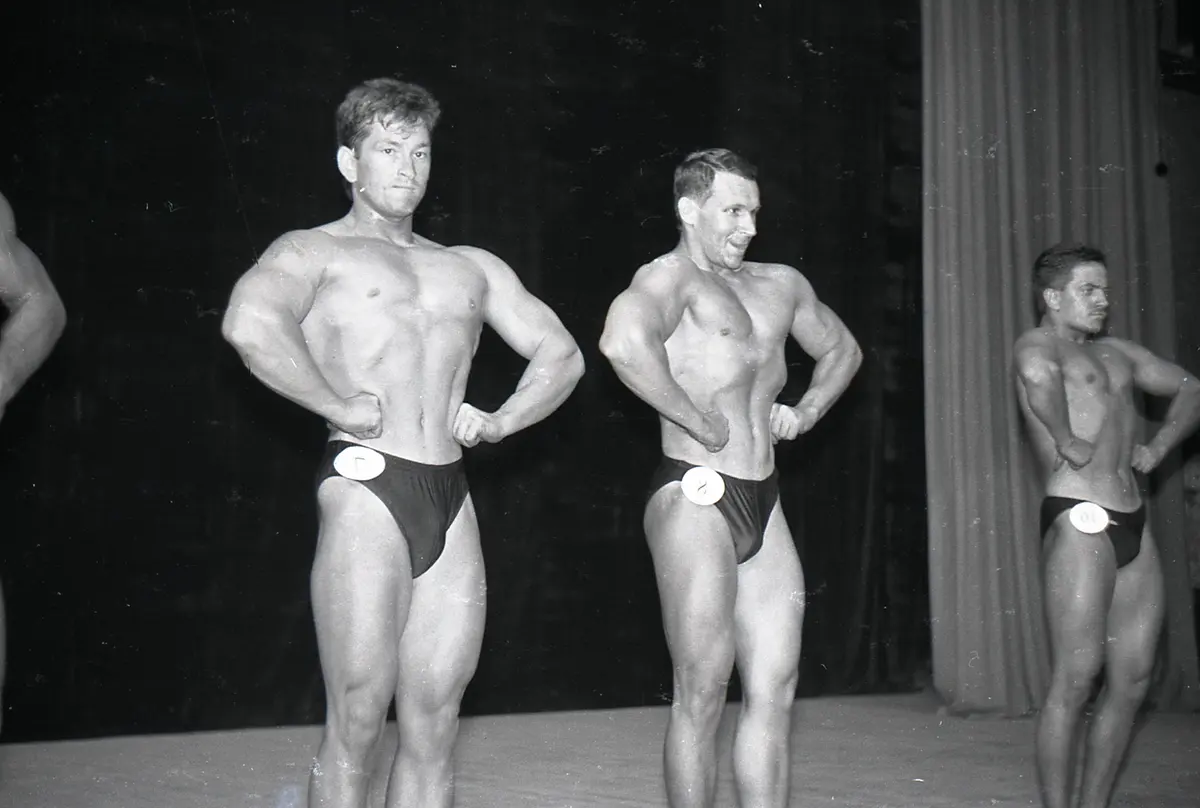
The frames of the nineties show how the work was organised, not only the spectacle: halls, the stages of early tournaments, the people who counted and decided. Three frames from 1999 were captioned by the archive with a single short word — «referee». The monograph places the formation of national tournaments in these same years, together with the appearance of women's categories in fitness and figure. The competition day was acquiring its full cast: participants, categories, referees.
How judging actually worked in 1992 or 1996, the documents do not say: no regulations or protocols from these tournaments are in the archive. The federation's present-day order is known precisely: registration and weigh-in, prejudging with eight compulsory poses and comparisons, a free posing routine in the final; five to nine judges work the line and the highest and lowest scores are excluded from the count. Projecting that order back onto the nineties would be guesswork.
1998: three tournaments in one season and a step beyond the capital
1998 is the densest year of the decade in the archive: three records in a row. On 26 April, «Mr. Tashkent 1998», ten frames. On 30 June, the show tournament the archive titled «Mr. Tashkent — Navoi 1998»; the chronicle volume reads one of the 1998 series as shot in Navoi, meaning the tournament map was already wider than the capital. On 28 December, «Mr. Uzbekistan 1998», recorded as a republican championship.
None of the three record cards names a venue: the place field is empty for all seven tournaments of the nineties. The federation is still collecting these details.
1999: «Mr. and Ms. Tashkent» and women on the same stage
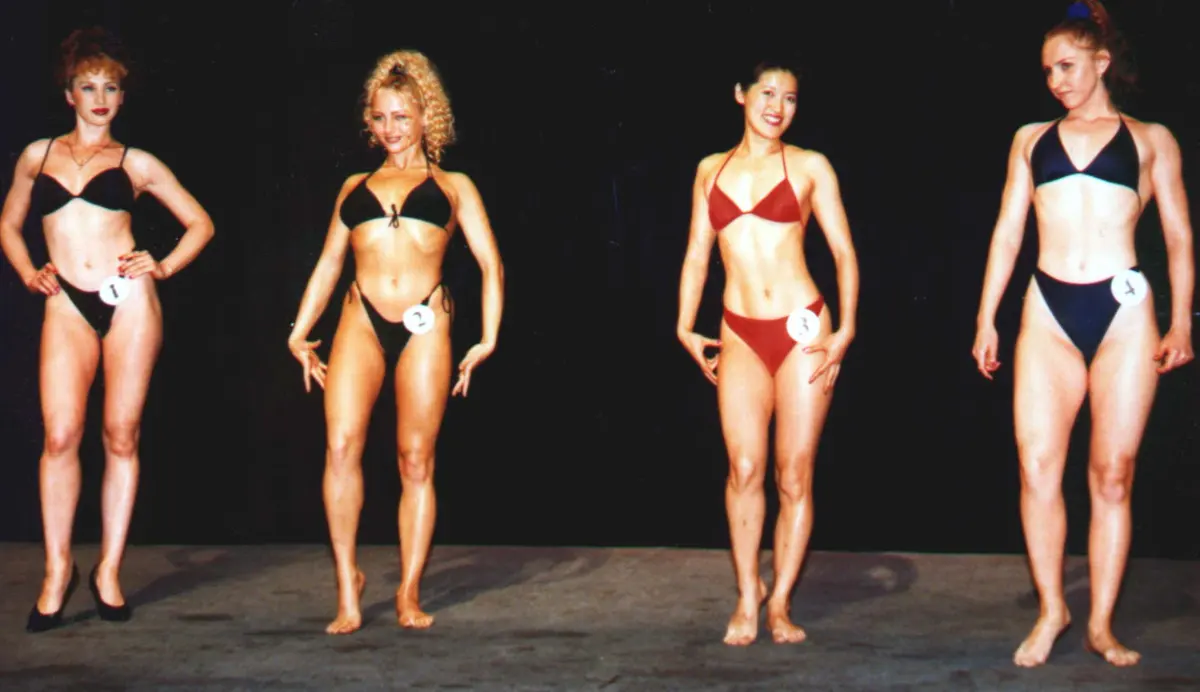
On 1 May 1999 the «Mr. and Ms. Tashkent 1999» tournament was held — 23 frames, the largest tournament series of the decade in the archive. The title matters more than the size: among all 137 tournament records in the archive this is the only one whose name puts the women's half beside the men's.
The monograph fits this into a longer line: the admission of women begins in 1989, and in the period from 1990 to 2000 the «Mr. and Mrs. Tashkent» and «Mr. and Mrs. Uzbekistan» tournaments take shape, along with women's categories — fitness and figure.
What the archive does not know about the nineties
An honest list of what the sources do not contain:
- Protocols and regulations are attached to none of the 1992–1999 tournaments. All seven records hold photographs only.
- Venues are not named in the record cards of the nineties — unlike the 1987 and 1989 records, where the place is given.
- Winners' names for these tournaments are not published in the archive. The rule of the chronicle is plain: where the name of a person in the frame is unestablished, the caption stays silent.
- The 1988 Leningrad protocol has not been found, so Yuriy Dementyev's place at the first USSR championship is not stated.
On 11 June 2025 the federation appealed to everyone who values the history of bodybuilding in the country to send in evidence: information about people, gyms, publications and the history of all years. The appeal still stands, and the nameless frames of the nineties still have a chance of getting their names back.
What came next: the year 2000, the 2006 federation and today's archive
The line does not stop at 1999. On 1 March 2000 came «Mr. Uzbekistan 2000» (26 frames), and on 18 December «Mr. Tashkent 2000» (30 frames). The photographic record grows denser: the seven tournaments of the nineties left 66 frames, while two tournaments of the year 2000 alone left 56.
In 2006 the Uzbekistan Bodybuilding and Fitness Federation was founded. Among those who played a key role in building the organisation, the monograph names Timur Sabirov; today he is the president of the federation (the chronicle volume spells his name Sobirov Timur Raisovich). From 2006 the chronicle is written in the first person, and the calendar no longer stands empty.
Today the public archive of the federation holds 225 records. Of these, 137 are tournament records — from 1987 to 2025, with 2 579 photographs. Separately it holds 140 documents: statutes and regulations, entry forms, season calendars and championship protocols by year. The nineties are where the line that has run almost without gaps since 1992 begins.
Where PROFORM stands in this history
The club's name appears in the federation archive from 2011. On 20 December 2011 the «Night of Champions 2011» show tournament was held at the Zerafshan concert hall, and the archive names the elite fitness club «PROFORM» as its organiser; the gold medal and the title of overall winner went to Khusanov Umid. From 2013 the archive carries the PROFORM Classic line — from «Night of Champions PROFORM Classic 2013» to the 2025 festival.
There is a smaller trace as well, first-hand. World champion Vitaliy Skripachev — first gold in classic bodybuilding in 2014, the world champion title in 2021 — names as his first coach Salim, who worked at the «Proform» gym.
And according to the chronicle, it all begins the same way for everyone. The president of the federation recalls being twelve years old in the late nineties: the boys from his yard called him into a newly opened basement gym, he walked in and saw the iron and the people at work. The equipment has changed since then. The first step has not.