
A bodybuilding competition protocol is the official closing document of a tournament. It records the date and venue, the composition of the judging panel, the list of every category contested and, for each category, the placings, the athletes' start numbers, their surnames and the city they represent. It is written neither by the winner nor by the organiser, but by the secretary of the competition. The Uzbekistan Bodybuilding and Fitness Federation keeps its archive in the open: it holds 140 documents, and the competition section of that archive covers 137 tournaments and events from 1987 to 2025. The protocol of the Uzbekistan Championship dated 30 November 2019 (Tashkent, Panoramny hall) is published in the record text itself, with all five judges named and the results listed category by category.
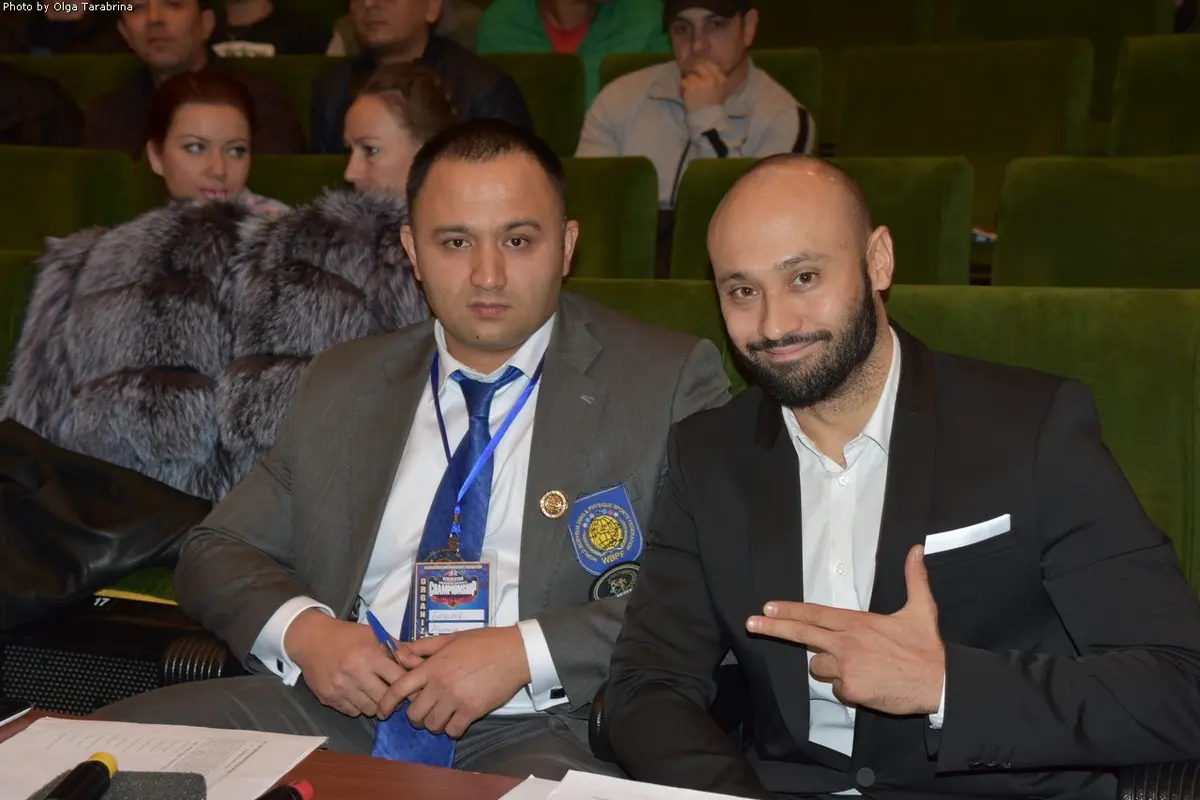
The protocol is written by the competition secretary, not by the winner
In bodybuilding the result is not taken off a stopwatch and not measured with a tape: it is delivered by people. That is why judging here is built as an institution. The judging panel consists of the head judge, the line judges, the competition secretary and the announcing judge. There are usually between five and nine line judges, and each of them scores independently of the others. When the scores are counted, the highest and the lowest are dropped, so the outcome is protected against a single strong opinion. The secretary processes the results, counts the points and draws up the protocol, and it is he who is the author of the document.
The announcing judge introduces the competitors and reports the results. The hall goes home with the names of the medallists, while the protocol keeps everyone who stepped on stage. The federation archive stores these protocols year by year, and they were written by the hands of the secretariat, not by the hands of the champions.
The judging procedure itself keeps changing. The report on the Tashkent Open Cup of 24 May 2015 is the first mention of an electronic judging system anywhere in the archive. And on 6 May 2017, at the Uzbekistan Cup, the judges moved out from behind their separate tables into the spectators' hall with a tablet in hand: glancing at a neighbour's protocol was no longer possible.
That system has a name and an archive record of its own, with four documents attached: ASET, an electronic system for the sports judging and scoring of competitions by means of mobile devices. It runs a tournament in three stages, registration with entry of the competitors into a database, qualifying rounds and final, and it produces a list of participants ready for printing and publication the moment registration closes. At the Uzbekistan Cup of 16 November 2016 at the Turkiston palace the hall judged through it as well: for the first attempt the number of spectator-judges was capped at fifty.
What exactly a competition protocol contains
The structure of the document is the same for a regional tournament and for a national championship. A protocol contains:
- the date and the venue;
- the judging panel, named individually and numbered;
- the name of every category contested, with its limits by sex, age, height or weight;
- the place taken within the category;
- the athlete's start number, the same number worn on stage;
- the athlete's surname and first name;
- the city or region represented.
Here is how that looks in a real document. Below is one category from the protocol of the Uzbekistan Championship dated 30 November 2019: Sports Physique (men), over 180 cm (+4 kg).
| Place | Number | Athlete | City |
|---|---|---|---|
| 1 | 91 | Bahrom Kholmurodov | Karakalpakstan |
| 2 | 13 | Mirozh Borisyuk | Tashkent |
| 3 | 22 | Mironshoh Jamolov | Bukhara |
| 4 | 54 | Daniel Fattakhov | Almalyk |
Four lines, and they hold the whole outcome of the category: who came out, where they travelled from, in what order the judges placed them. The judging panel of that tournament is named as well, by number: 1 — Akmal Bazarov, 2 — Andrey Gayvoronsky, 3 — Bakhtiyor Khaydarov, 4 — Sergey Nenashev, 5 — Eldar Kholmatov.
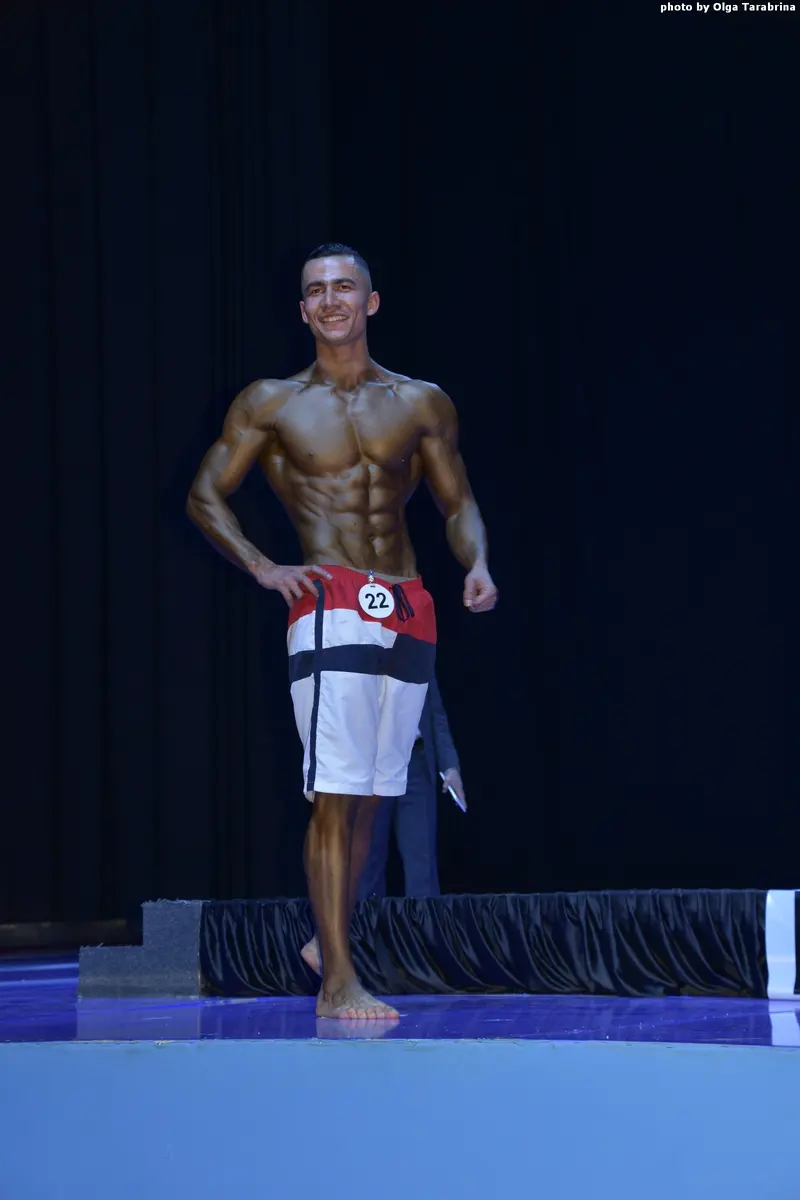
Why the protocol puts kilograms next to a height
A category is a way of comparing what can be compared. In classic bodybuilding athletes are separated by weight: the accepted categories are up to 70, up to 75, up to 80, up to 90 and over 90 kilograms. In the category grid of the GENERATION IRON SHOW UZFBF 2025 tournament, held on 24–25 May 2025 in Chirchiq, men's bodybuilding is split more finely: up to 60, 65, 70, 75, 80, 85, 90, 100 and over 100 kilograms, with juniors listed on a line of their own and masters split into age groups of 40–49, 50–60 and over 60.
Where proportions are compared, athletes are separated by height. Hence the line that puzzles a newcomer: "up to 170 cm (−2 kg)", "up to 175 cm (0 kg)", "up to 180 cm (+2 kg)", "over 180 cm (+4 kg)". Height sets the category, the bracket carries a weight correction, and along this series the correction rises together with the height limit. The categories in the protocol of the 2020 Uzbekistan Cup are written out exactly this way.
The order of the tournament that the protocol fixes
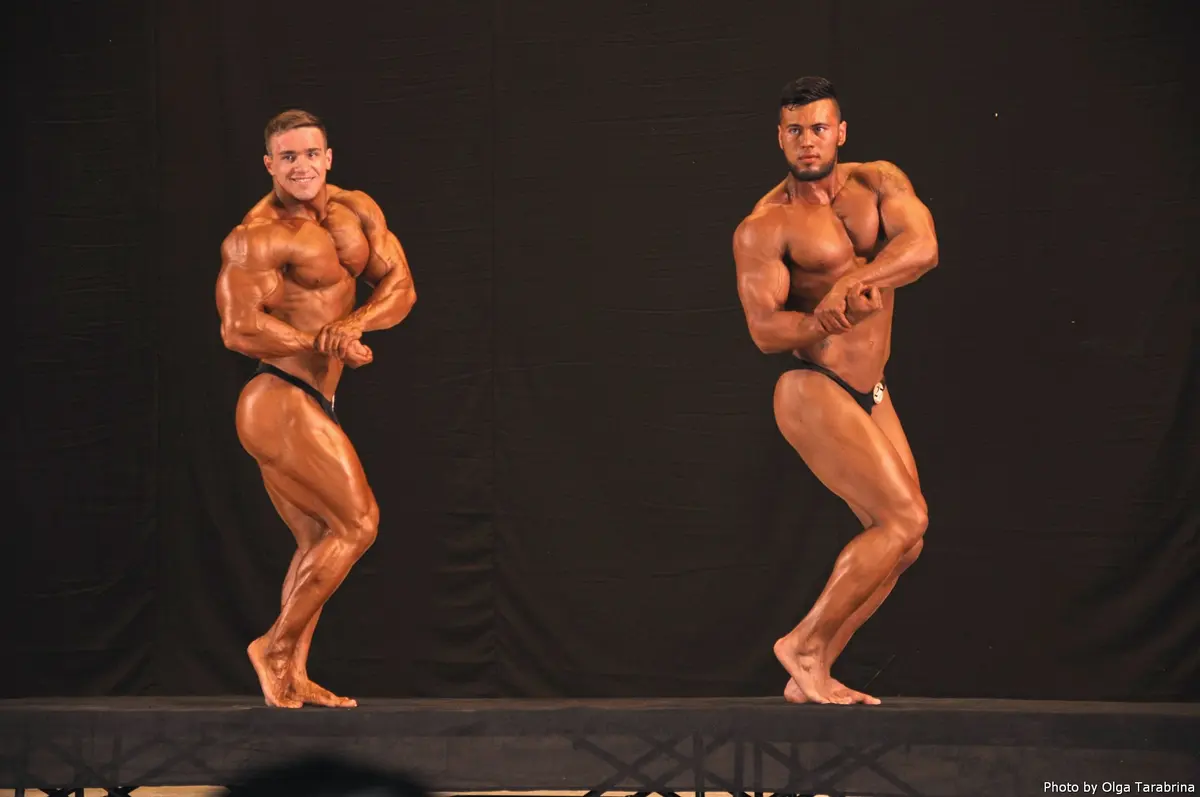
A competition day always runs the same way: registration and weigh-in, prejudging, final, awards. Registration decides who will be compared with whom: that is where an athlete is weighed in and assigned to his category. At prejudging the competitors perform eight compulsory poses:
- front double biceps;
- front lat spread;
- side chest;
- back double biceps;
- back lat spread;
- side triceps;
- abdominals and thigh;
- most muscular.
The judges then call the competitors on stage in different combinations: the assessment is born out of comparison. The final brings the free posing routine. The final results are announced only after all stages are complete, and only then is the protocol closed.
The 140 documents in the archive are not only protocols
Honesty is needed here, otherwise the figure ends up prettier than the truth. The federation archive holds 140 documents, and championship protocols by year are only one kind among them. Beside them lie statutes and regulations, entry forms of participants, and season calendars. The competition section of the archive holds 137 records from 1987 to 2025 and 2,579 photographs; attached files appear in 47 records, 75 files in total. In 32 records the results are written out line by line in the page text itself, in the form "place — start number — surname (city)", and 29 records name the judging panel individually, by number. The earliest record carrying such a line-by-line protocol in its text is the Jizzakh Region Open Championship of 8 May 2016.
These records carry the most attachments:
| Tournament | Date | Venue | Files |
|---|---|---|---|
| Tashkent Open Cup | 24.05.2015 | Tashkent | 7 |
| Uzbekistan Championship | 16.01.2016 | Turkiston palace | 6 |
| Asian Championship | 2014 | not stated in the record | 6 |
| Andijan Open Championship | 01.05.2016 | Andijan | 3 |
| Jizzakh Region Open Championship | 08.05.2016 | Jizzakh | 3 |
| Tashkent Open Cup | 13.08.2017 | Tashkent | 3 |
International tournaments bring documents of another kind. Attached to the record of the 2014 Asian Championship is a letter from Datuk Paul Chua, Secretary-General of the ABBF and the WBPF, listing six documents: inspection report, rules and regulations of the competition, final entry form, day-to-day programme, media accreditation form and judges nomination form. One caveat: the record is titled "48th Asian Championship", while the letter itself speaks of the inspection of the 49th Asian Championships in Macau from 26 August to 1 September 2014, and the record carries no venue field at all. We do not resolve that discrepancy by guesswork; only a document can settle it.
What happens when there is no protocol
The best answer to the question of why this document matters comes from a case where it was not found. The federation archive holds photographs from 1988 captioned "Yuri Dementyev"; the archive calls him a medallist of the first official USSR bodybuilding championship, held in Leningrad from 26 to 28 May 1988. Which place he took would be told by the Leningrad protocol. That protocol has not been found to this day.
For that reason the federation's book states no place and never uses the word "winner": it uses only the precise word "medallist", and leaves the line empty until the day a document confirms it. That is the value of a protocol. Without one you are left with a photograph, a memory and a polite "I think so". With one you are left with a fact.
The protocol as a relic
From 1 to 7 October 2021 Tashkent hosted the WBPF World Bodybuilding and Fitness Championship. The archive record of that tournament is short: results as a separate PDF, photographs, video. And the federation's book carries a spread on which a 2021 tournament protocol and a medal are photographed against a dark background the way a museum object is photographed: studio light picking out the texture of the paper, the embossing, the ribbon.
Documents speak quietly, but they are believed the longest.
A competition evening makes its noise once. A line in a protocol holds for decades, and in thirty years it is that line, not anyone's recollection, that will answer the question of who came first.
Where to start reading the archive
- Uzbekistan Championship, 30 November 2019 — the protocol is published in the record text itself: judges, categories, places, numbers, cities.
- WBPF World Championship 2021 in Tashkent — the results are posted as a separate PDF file.
- Uzbekistan Cup 2020 — shows how height categories with weight corrections are built.
- Tashkent Open Cup, 24 May 2015 — seven documents and the earliest mention of an electronic judging system in the archive.
- Asian Championship 2014 — the package of international ABBF and WBPF documents.
The full archive is open on the website of the Uzbekistan Bodybuilding and Fitness Federation: 137 tournaments and events, from the Sparta gym of 1987 to the records of 2025.
Where the people whose names reach the protocol train
A protocol begins not on stage but at registration. Part of that registration has literally taken place in a gym: advance registration for the 2020 national championship ran at the PROFORM sports club on 6 and 7 August from 10:00 to 18:00, and the participants of the 2023 festival were registered there as well, on 2 June. The Uzbekistan Championships of 2019 and 2020 were held within the PROFORM Classic Sports Festival. The president of the Uzbekistan Bodybuilding and Fitness Federation is Timur Sabirov.
PROFORM DINAMO. Address: 8a Mirzo Ulugbek Avenue, Tashkent. The club is open around the clock, a tour of the club is free, phone +998 94 045 54 48.