Documented bodybuilding in Uzbekistan begins at the "Sparta" gym in Tashkent. Twenty-eight frames of black-and-white film from 1987 are the earliest photographs in the entire archive of the Bodybuilding and Fitness Federation of Uzbekistan. The archive inventory gives the gym's address as: Tashkent, Kirov Central Park of Culture and Leisure, 1986–1989. From that entry up to 2025 the open archive runs 137 records of tournaments and events. Everything before it lived without a common name: weightlifting, "athletic gymnastics", health groups. With this film, history acquires a place, a year and a photograph.
Where bodybuilding in Uzbekistan began: the "Sparta" gym, Tashkent, 1987
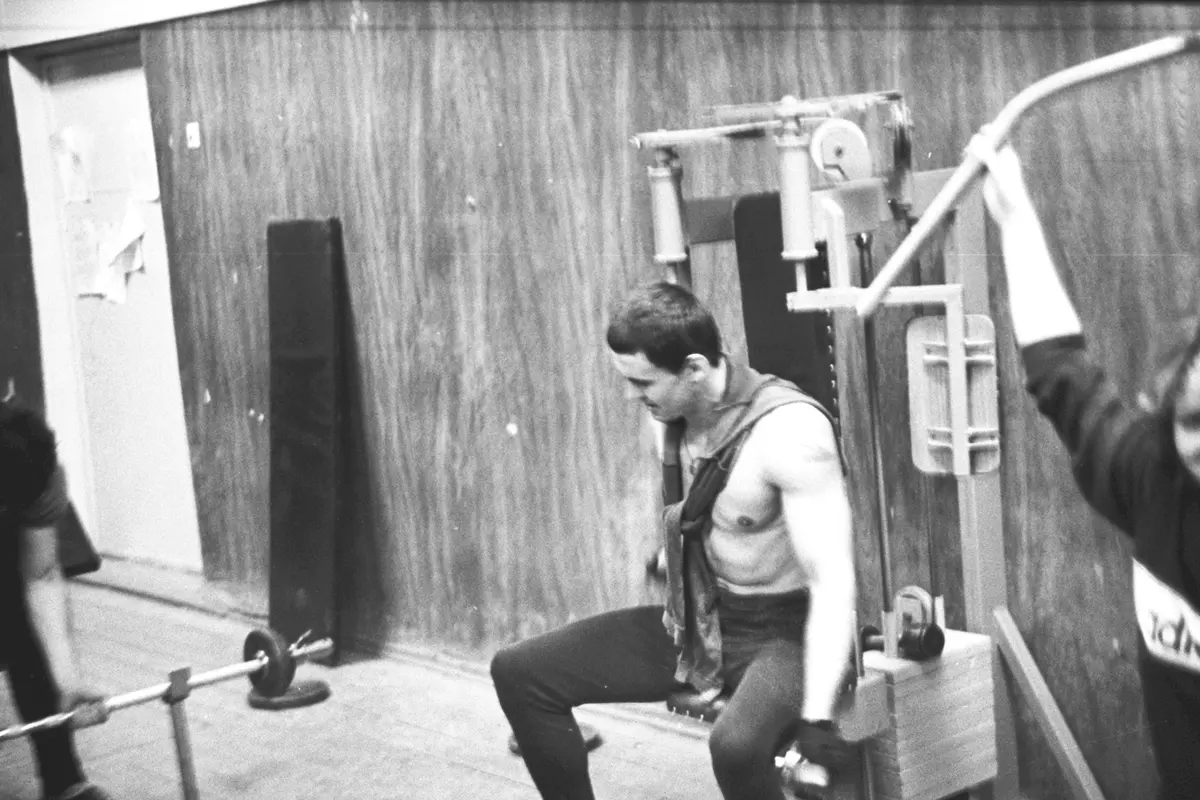
The archive record calls "Sparta" a cult place for the bodybuilders of Tashkent in the 1980s and 1990s. The series holds twenty-eight frames: training suits, iron, concentrated faces. Nobody poses, everybody works. This film is the heart of the federation's entire early collection.
The way the archive is captioned matters just as much. The captions state only what is established: the place, the years, the line of provenance. Where the name of the person in the frame has not been confirmed, the caption stays silent; the federation continues to collect material on its own history, and the nameless frames still have a chance of recovering their names. The archive shows the gym, not the legend of the gym.
Before "Sparta", strength in this country lived without a barbell
Asking where bodybuilding began, it is easy to confuse two different beginnings. Bodybuilding as a competitive discipline with a gym, a barbell and a stage begins with "Sparta". Respect for human strength began here many centuries earlier, and that is a separate chain of evidence: a silver bowl showing two wrestlers, the word kürāş in the dictionary of Mahmud al-Kashgari of 1072–1074, a rule of contest recorded by an eyewitness in Samarkand in 1404, Vámbéry's count of prizes, the thousands of spectators reported by Lykoshin. In Khiva a mausoleum stands over the grave of the wrestler and poet Pahlavon Mahmud: the memory of strong people is kept here for centuries.
The federation's own volume, which assembled that chain, prints its weak links openly. The silver bowl was found not in Central Asia but on the Don near Azov. Not a single testimony about Pahlavon Mahmud dates from his lifetime, and the book treats only the year of his death as firm: 722 AH, that is 1322. The book draws no direct line of transmission from that tradition to the "Sparta" gym, and neither will we. But the country's habit of respecting a strong man was not created by "Sparta". It was inherited.
The mid-twentieth century: "polvonlik" met the iron
In the 1940s and 1950s Tashkent became one of the largest centres of weightlifting training in Central Asia. In the sports societies "Dinamo", "Spartak" and "Mehnat" athletes grew up who were known not only for strength but for proportionally developed muscle: public attention was gradually shifting from records to the aesthetics of the physique. Among the first masters of sport was Shakhobiddin Eshonkhodjaev; the heavyweight Turgun Kershaev combined strength results with an athletic build. The "Mehnat" club stood by the Alay bazaar, gyms operated near the Gospitalny bazaar, and at the "Pakhtakor" and "Spartak" stadiums athletes appeared in physical-culture parades with posing elements and acrobatic pyramids.
By the early 1960s interest in "athletic gymnastics" had become widespread, but the official word "bodybuilding" did not yet exist: training was legalised under the label of health groups attached to stadiums and palaces of culture. In the 1960s and 1970s the first athletic gyms opened at sports societies, educational institutions and industrial enterprises. The equipment was simple: barbells, kettlebells, dumbbells and the most basic machines.
Why it all moved so slowly is explained by the Soviet context. This sport made its way with difficulty and late across the whole country:
- 1962 — the first bodybuilding gym opened in Leningrad;
- 1966 — the first Moscow tournament gathered twenty-seven athletes;
- February 1971 — the first unofficial championship of the Union was held in Severodvinsk;
- 1986 — the first legal tournament in the country took place, two years before the Leningrad championship;
- 26–28 May 1988 — the first official USSR championship was held in Leningrad.
The 2026 monograph names the 1980s plainly: the era of "basement" enthusiasm. There was no methodological base, knowledge was mined from translated literature, and machines were built by hand. That is when the core of the first coach-mentors took shape. "Sparta" is a photograph of that era taken from the inside.
1988: Yuri Dementyev and a caveat worth repeating
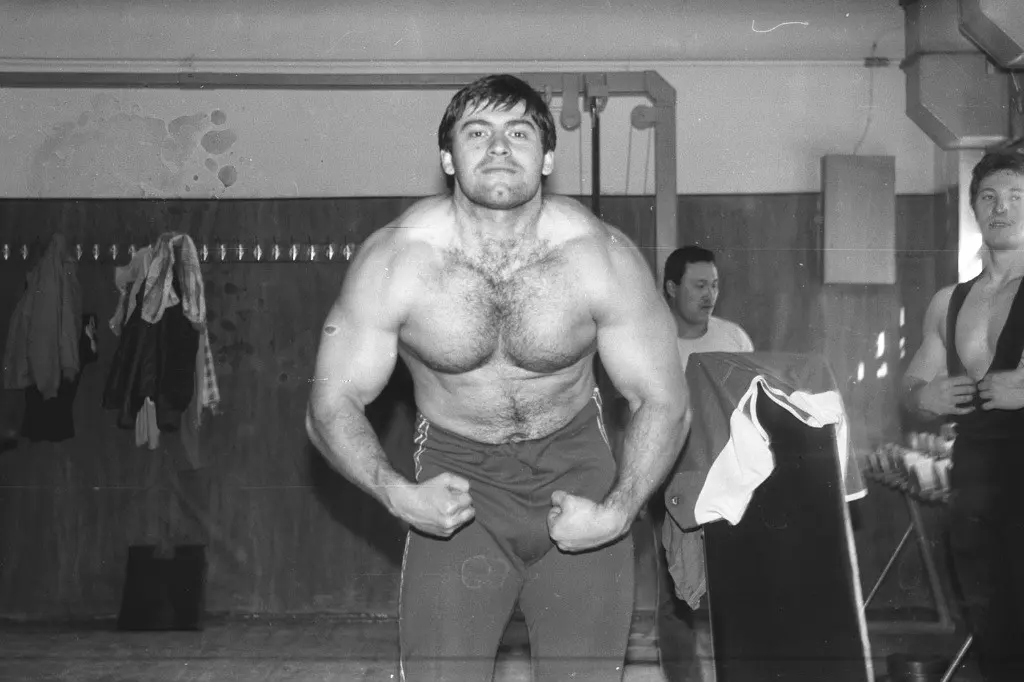
The federation's archive holds photographs from 1988 captioned "Yuri Dementyev" and calls him a medallist of the first USSR bodybuilding championship. In the chronicle of Uzbekistan, the first all-Union stage of this sport is tied to his name.
And here the federation's volume adds a caveat that is more honest to repeat than to smooth over: the protocol of the Leningrad championship of 26–28 May 1988 had not been located by the time the book went to press. For that reason the exact placing is not stated and the word "winner" is not used. Until the document is found, the chronicle holds to the precise word "medallist", and the search for the protocol is part of the federation's archival programme. This is what conscientious history looks like: the line is left blank until it is confirmed.
1989: the first open championship of Tashkent
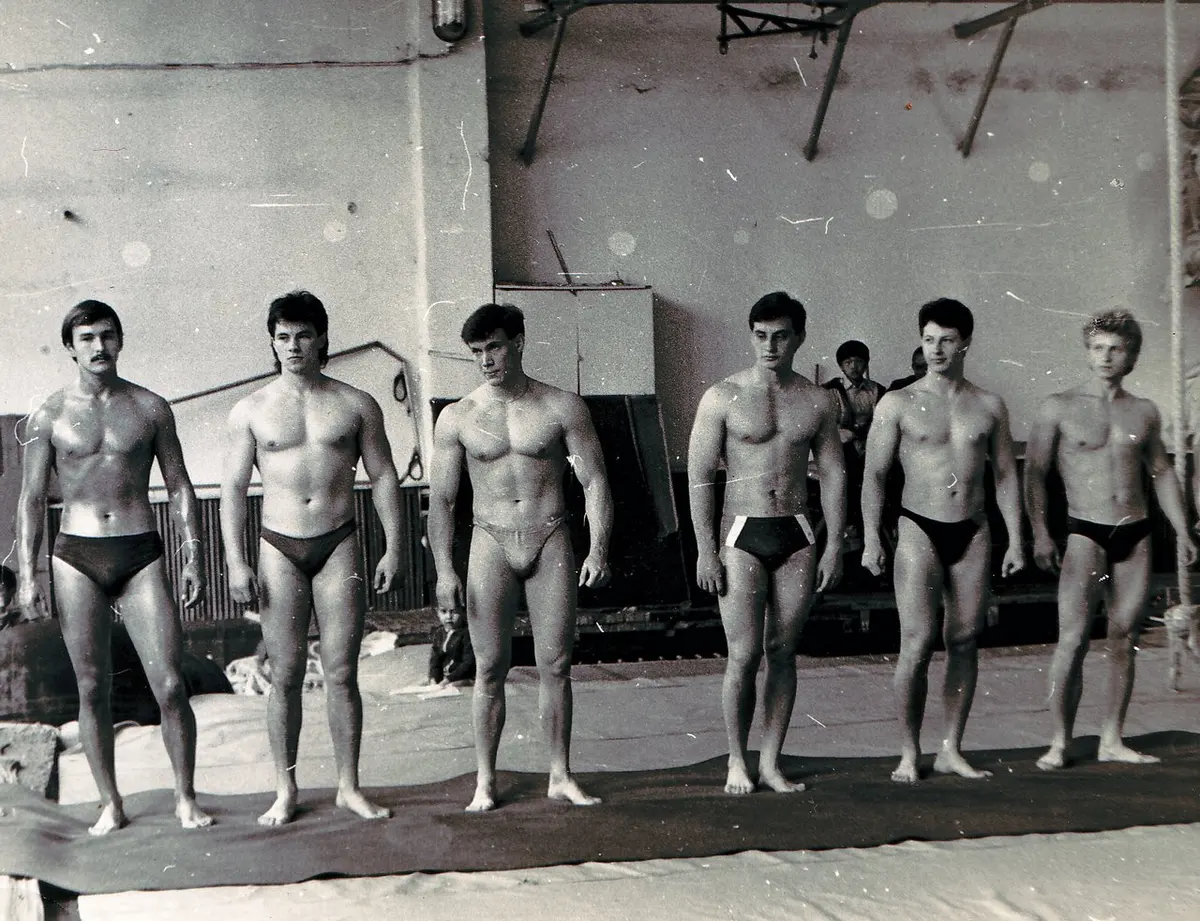
A year later competitive life came home. In 1989 the open bodybuilding championship of Tashkent took place; eight frames survive in the archive, and here the captions already name the participants individually. The inventory gives the venue as the sports complex of the Lenin Komsomol Central Park of Culture and Leisure, which by the inventory is a different park from the one where the "Sparta" gym stood. The 2026 monograph gives 1989 its own row in its table: the first official competitions, and the beginning of women's admission to the sport.
The early dates: what exactly the open archive holds
From 1992 onwards the line of the "Mr. Tashkent" and "Mr. Uzbekistan" tournaments runs almost without gaps. Below are all the records in the federation's open archive up to and including 2000, with the number of surviving frames.
| Year | Archive record | Place or date per the inventory | Frames |
|---|---|---|---|
| 1987 | "Sparta" gym | Tashkent, Kirov Park, 1986–1989 | 28 |
| 1988 | Yuri Dementyev, medallist of the first USSR championship | "Sparta" club, 1988 | 3 |
| 1989 | Open Championship of Tashkent | Lenin Komsomol Park sports complex | 8 |
| 1992 | Mr. Tashkent | 26 December 1992 | 7 |
| 1993 | Mr. Uzbekistan | 20 November 1993 | 4 |
| 1996 | Mr. Tashkent, open tournament | 27 November 1996 | 8 |
| 1998 | Mr. Tashkent | 26 April 1998 | 10 |
| 1998 | Mr. Tashkent — Navoi, show tournament | 30 June 1998 | 7 |
| 1998 | Mr. Uzbekistan, republican championship | 28 December 1998 | 7 |
| 1999 | Mr. and Ms. Tashkent | 1 May 1999 | 23 |
| 2000 | Mr. Uzbekistan, republican championship | 1 March 2000 | 26 |
| 2000 | Mr. Tashkent | 18 December 2000 | 30 |
That is one hundred and sixty-one frames across twelve records. Two details in this table are worth a paragraph of their own. One of the 1998 series was shot in Navoi: the tournament map was already wider than the capital. And in 1999 the archive captions three frames with a single short word for the first time — "referee". The competition had acquired its second face: the judging table, the regulations, the protocol. The line starts with "Mr. Tashkent" on 26 December 1992.
From the basement to a federation: 2006
In 2006 the Bodybuilding and Fitness Federation of Uzbekistan was founded. In the monograph's chronicle the line carries a restrained name: centralisation of the management of the sport. Behind the bureaucratic word lies a simple change: clubs and tournaments that had lived on self-organisation for years received a single set of regulations, a single calendar and a single address of responsibility.
Alexander Sakharov, a future international-class master of sport, learned that the federation had appeared and that the first championship would take place "in literally 10 days", dropped everything and began preparing.
The photo chronicle confirms how dense that year was: the Championship of Uzbekistan of 2 April 2006, thirty frames, and the Uzbekistan Cup of 1 October the same year, twenty-one frames, sit side by side: fifty-one frames from one season. In the first days of January 2013 the federation's website announced that it had joined the world federation WBPF and the Asian ABBF.
The whole road from "Sparta" to today's calendar is open on the federation's website. By the count of the 2026 volume, the federation's photographic archive holds 2,904 images, and its document collection 140 documents: statutes and regulations, entry forms, season calendars and championship protocols by year. Today's open archive counts differently: 2,623 photographs across the whole archive, 2,579 of them in the 137 tournament and event records from which the table above is built.
The line did not break: where this sport trains today
The gym that was the centre of gravity in 1987 has been replaced by other addresses, but the role is unchanged. In the federation's archive PROFORM appears both as a venue and as a tournament: the "Night of Champions PROFORM Classic" of 13 April 2013, the master class by world bodybuilding legend Flex Wheeler at PROFORM on 12 April 2013, and the series of PROFORM Classic festivals that runs in the archive up to 2025. The first coach of world champion Vitaly Skripachev was Salim from the PROFORM gym. The federation's president is Timur Sabirov (Sobirov Timur Raisovich); by his own account he spent about twenty years testing his system, first on himself and then on his own students.
If this page leaves you wanting to train rather than read: PROFORM DINAMO, 8a Mirzo Ulugbek Avenue, Tashkent. The gym is open around the clock, a club tour is free, phone +998 94 045 54 48. The 1987 film began with exactly this: a person walked into a gym and picked up the iron.