
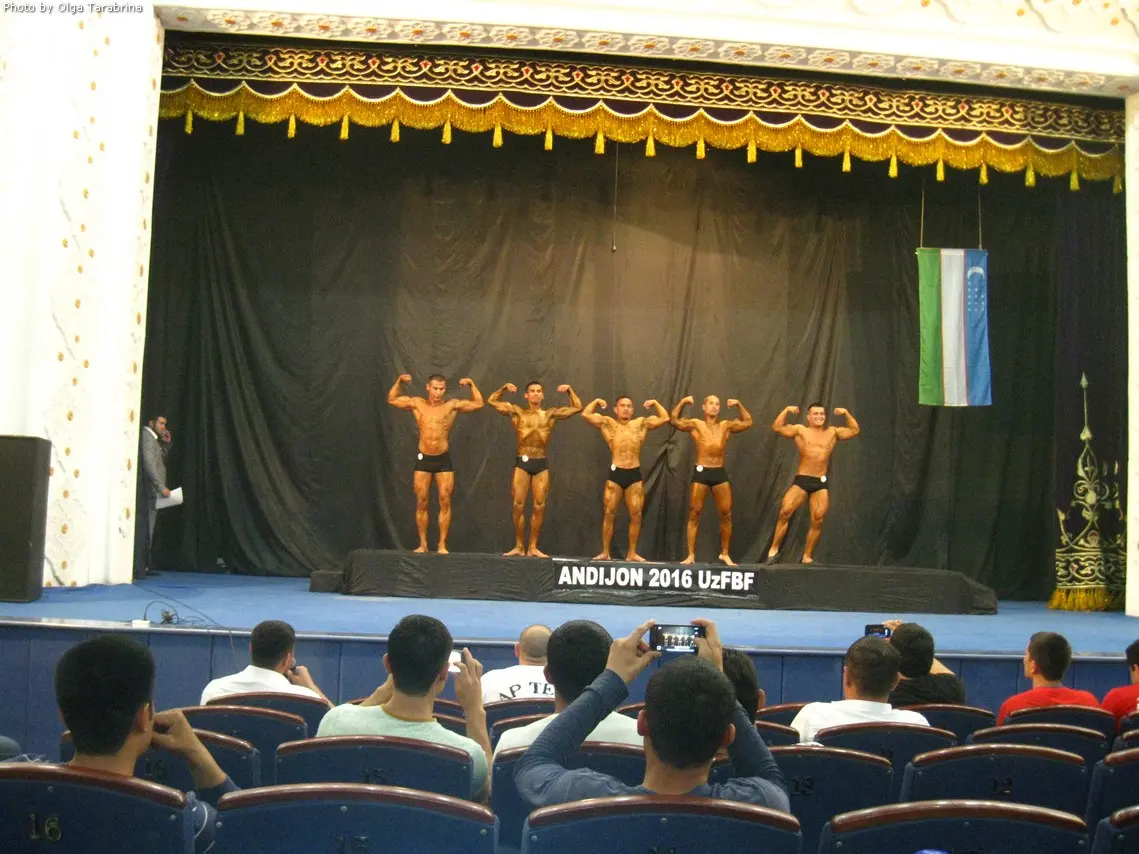
Bodybuilding is judged on five criteria: muscle mass, body symmetry, proportions of the physique, muscle definition and stage presentation. The verdict comes from a judging panel — a head judge, five to nine line judges, a competition secretary and an announcing judge. Each line judge scores independently of the others, and the highest and lowest scores are dropped when the totals are counted. A tournament runs through two scoring stages: prejudging with eight mandatory poses, and a final with a free posing routine. In Uzbekistan this order is kept by the Uzbekistan Bodybuilding and Fitness Federation: on 7 March 2016 it published the attestation procedure for judging candidates, and in April of the same year six people from Andijan and Jizzakh were admitted to official judging.
There is no stopwatch here, so there is a procedure
In most sports the result is measured: time, weight, distance. In bodybuilding the result is delivered by people, and the assessment rests on a visual analysis of the physique. That is why a strict procedure is built around the judge's eye: a fixed order of inspection, comparison of athletes against each other, independent scoring, and the removal of extreme marks.
Exactly how to look is written into the rules the federation has published openly. The section "Bodybuilding and Athletic Physique" states it plainly: when comparing mandatory poses the judge first looks at the muscles named in the pose, and only then studies the whole physique — starting at the head and working down in order, from general appearance to muscle mass, balance of development and the degree of muscular refinement. The inspection covers head, neck, shoulders, chest, all the muscles of the arms, the front of the torso, abdominals, waist, hips, legs, calves and feet. In the back poses the upper and lower trapezius, the teres and infraspinatus group, the lower back, the glutes and the hamstrings are added.
The five judging criteria are the answer to "what are places awarded for"
- Muscle mass. Overall volume and density of the muscles, and how evenly that mass is distributed across the body.
- Body symmetry. Even development of the right and left halves.
- Proportions. The relationship between body parts: broad shoulders and a narrow waist give the classic V-taper.
- Muscle definition. How clearly the detail shows, which depends on subcutaneous fat and the quality of preparation.
- Stage presentation. The ability to pose, to hold yourself on stage and to show the condition for what it is worth.
An important detail: judges do not assess athletes one by one, they assess them against each other. That is why during prejudging competitors are called on stage in different combinations — each athlete's strengths and weaknesses show up more precisely that way.
The eight mandatory poses in bodybuilding
| No. | Pose |
|---|---|
| 1 | Front double biceps |
| 2 | Front lat spread |
| 3 | Side chest |
| 4 | Back double biceps |
| 5 | Back lat spread |
| 6 | Side triceps |
| 7 | Abdominals and thighs |
| 8 | Most muscular |
Athletes perform these eight poses during prejudging. The final brings the free routine, and the panel may run a repeat comparison if it needs to settle the order of the medal places. Final results are announced only after every stage is complete.
How a competition day is built
The running order is fixed in the federation document "List of documents for organising national competitions". The recommended schedule there is set out by the hour:
| Time | Stage |
|---|---|
| 10.00 — 12.00 | Registration |
| 12.00 — 15.00 | Qualifying round |
| 18.00 — 21.00 | Final |
Registration and the weigh-in settle the thing that makes a fair comparison possible: who will be compared with whom. Classic bodybuilding uses weight classes up to 70, up to 75, up to 80, up to 90 and over 90 kilograms; where proportions are being compared, athletes are split by height. Age draws its own line: juniors, seniors, masters. In the regulations of the "OASIS BEACH FITNESS 2021" tournament it looks like this: women's model physique is split into "up to 165 cm" and "over 165 cm", men's sport physique into "up to 180 cm" and "over 180 cm".
Who sits at the judging table
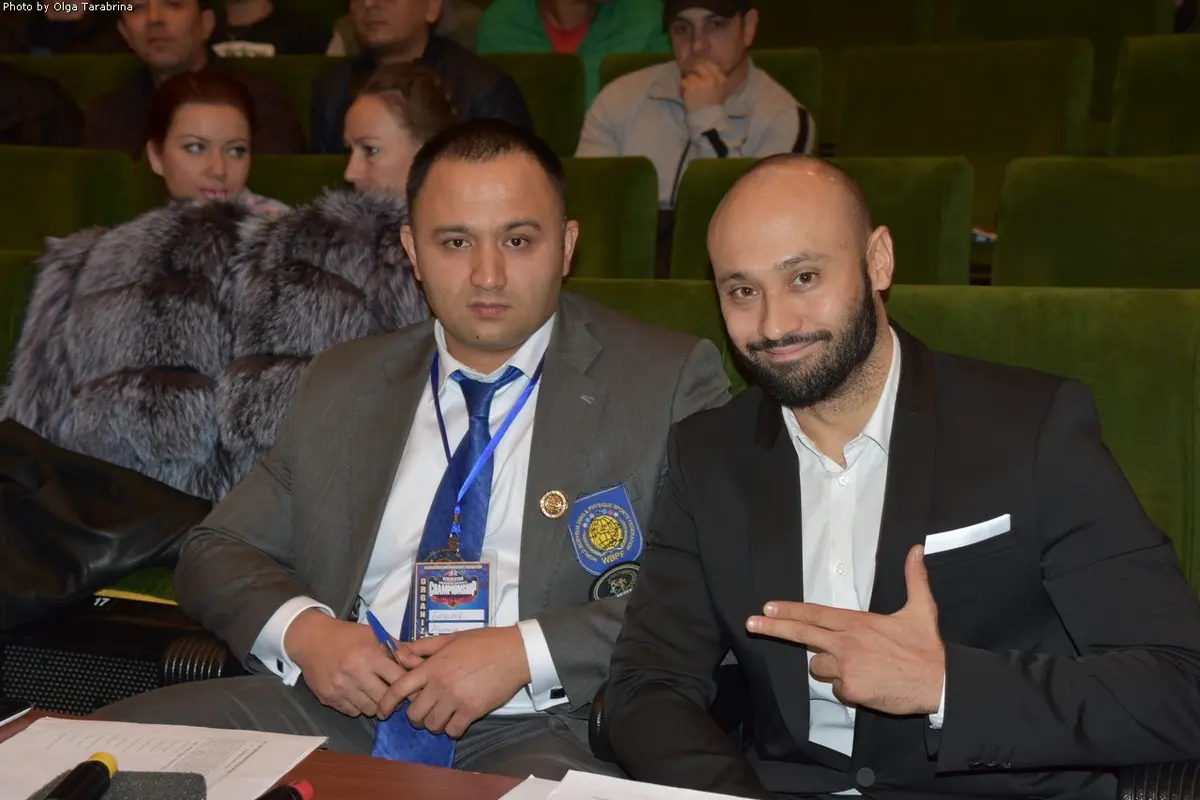
The judging panel of a competition consists of the head judge, the line judges, the competition secretary and the announcing judge. The head judge runs the event and enforces the rules. There are usually five to nine line judges, and each scores independently of the rest. The secretary counts the points and draws up the protocols. The announcing judge introduces the competitors and reads out the results.
Honesty is owed here: the sources do not give one single list of posts. The federation's 2016 regulations name, alongside the head judge, a marshalling judge, a statistics judge and assistants. The composition of the panel depends on the level and format of the tournament.
How many judges are actually looking at you was described best by Aleksandr Sakharov, silver medallist of the 2013 WBPF World Championship in Budapest. He remembered that championship as an examination of the judges' attention: more than thirty athletes stood on the podium in three rows, and you were given a few seconds to show yourself to eight judges.
How you become a judge in Uzbekistan
On 7 March 2016 the federation published the attestation procedure for candidates for the post of judge. It has two stages.
- Theory. How competitions are organised, the federation's system of categories, anatomy, and cross-questioning on the judging criteria.
- Practice. The candidate judges the prejudging round unofficially, sitting alongside the serving panel. Only if the candidate's scores converge with those of the official judges does the head judge admit them to the final round.
After that the name is entered in the general register of judges, and the authority is confirmed by a separate document, the judge's passport. It is issued on the joint decision of the chairman of the judging panel and the chairman of the attestation commission. The federation's published register holds twelve names, with categories running from third to international and a status note beside each name.
In April 2016 the federation named those who had passed the latest attestation: Alina Yafizova, Diyerbek Matkarimov and Sardorbek Tukhtarov from Andijan; Farkhod Uralov, Nodir Yusupov and Bunyod Normatov from Jizzakh. All six were cleared to judge at the federation's May tournaments. In May 2016 the federation held the Andijan Open Championship (1 May) and the Jizzakh Region Open Championship (8 May).
Different categories are judged differently
| Division | What is looked at first |
|---|---|
| Bodybuilding | Muscle mass, definition, body symmetry |
| Classic Physique | Harmony of the physique and aesthetics; weight limits apply according to height |
| Men's Physique | The upper body: shoulder girdle, broad shoulders, narrow waist, overall aesthetic look |
| Bikini Fitness | Harmony of proportions, tone, a slim figure, confident presentation; excessive mass and definition are not welcome |
| Wellness | Development of the lower body, glutes and thighs, while keeping the proportions |
| Fitness | The free routine: difficulty and technique of the elements, artistry, plus the aesthetics of the physique |
The difference between the categories is not cosmetic, it is operational. In the federation's rules for fitness and model physique the judges are reminded outright that they are assessing a fitness physique, not a bodybuilding one, and that muscle bulk, vascularity, muscle separation or thinness caused by dieting are considered unacceptable here. The same text says that a competitor's posture and bearing count for the whole time they are on stage — standing in line, walking the stage, and during the assessment of the turns.
What the federation changed to make judging fairer
First, the technology. The archive holds a description of the ASET electronic judging system: scoring from mobile devices over a secured local network, without the internet, supporting three stages — registration, the qualifying round and the final.
Second, the seating. On 6 May 2017 at the Uzbekistan Cup the procedure changed: the judges left their separate tables for the auditorium, sitting among the spectators with nothing but a tablet in hand. The federation's own report names the point of it: there is no longer any way to glance at a neighbour's protocol or chat comfortably with each other.
Third, the people. Training judges and coaches is written as a separate line among the federation's tasks. On 21 February 2014 the federation published examination tickets for instructors: thirty tickets, each with a theory question, two client cases and a question on how competitions are organised — from weight classes and mandatory poses to the WBPF divisions.
What we honestly do not know
The sources disagree on how judging categories are described. The federation's register lists categories "from third to international". The 2026 monograph describes the ladder differently: national judge, international judge, judge of the highest category. The available documents do not let us map these two scales onto each other, and we will not pretend otherwise.
The rest you can check yourself: the federation archive is open. It holds 137 tournament pages from 1987 to 2025, 2,579 photographs attached to those tournaments, and 140 documents — statutes and regulations, competitor entry forms, season calendars and championship protocols by year.
What this means for anyone who wants to compete
Read the criteria as a brief and the picture is simple. Symmetry and proportions are built over years and by plan, not by a final cut. Definition is settled by preparing for a specific date. Stage presentation is a separate skill, and the federation has run posing seminars since its earliest years.
Where to train for it in Tashkent
PROFORM DINAMO is a fitness club in Tashkent; its founder, Timur Sabirov, is the President of the Uzbekistan Bodybuilding and Fitness Federation. The PROFORM name has stood in the federation's archive since 2011: the club organised the "Night of Champions 2011" show tournament, and later the PROFORM Classic name carried festivals and national championships.
Address: Mirzo Ulugbek Avenue 8a, Tashkent. The club is open around the clock. A tour of the club is free. Phone +998 94 045 54 48.